Book Review: The Ministry of Time by Kaliane Bradley

The Ministry of Time // Kaliane Bradley

Thanks to the publisher for providing a complimentary review copy.

In a near future our unnamed narrator, a British-Cambodian translator with the British Ministry of Defence, is selected for a lucrative position with a new secretive agency aiding high-value refugees assimilate to society. What she doesn’t realize is just how far away these refugees have traveled; not merely from across the globe, but across time.

The “expat” she is assigned is Victorian polar explorer Lt. Graham Gore a real life historical figure who died in the ill-fated 1845 Franklin expedition, here plucked by the British government via time travel technology just before meeting his doomed fate and installed in our narrator’s modern day home where she is to be part roommate, part case worker, and most importantly a guide to modern living. As intimacy and romantic feelings begin to develop her loyalty becomes divided between her well-mannered and handsome Victorian ward and her increasingly sinister government employers.

The Ministry of Time is a fresh, genre-bending romp; something along the lines of speculative fiction meets spy thriller meets historical adventure meets rom-com. I liked the broad strokes of the story and appreciated the deeper themes it teases at such as historical narrative shaping our reality, imperial/colonial critique, and the displacement felt by those impacted by empire.

There’s a lot going on here and I wouldn’t say it all fits together seamlessly, but I sort of enjoyed the chaos of it all and I loved learning this book began as pandemic era Graham Gore fanfiction for Kaliane Bradley’s friends!

This book ended up being something different than I had anticipated, though I’m not exactly sure what I was expecting. The vibe is not unimportant to the success of the story and it’s a little hard to pin down. I think Lindsay Lynch of Parnassus books comes closest that I have seen describing it as: like Bill and Ted’s Excellent Adventure had a baby with a spy thriller and that baby was raised by Emily St. John Mandel.

Tell me: if you could time travel to a different time in the past or future when would it be?

Book Review: A Better World by Sarah Langan

A Better World // Sarah Langan

Thanks to the publisher for providing a complimentary review copy.

Set several decades in the future in a very believable America, Linda, a doctor, her husband, a scientist recently laid off by the EPA, and their two teen children score a much coveted spot in a company town called Plymouth Valley. While the world outside descends into increasingly uninhabitable chaos the residents of this bucolic town are safe, breathing clean air, living in beautiful houses, and working for the eco-friendly company that owns the town in exchange for the privilege. And a truly elite privilege it is as this population aren’t just 1%ers, they’re more like 0.0001%ers.

But the Farmer-Bowens aren’t permanent residents of this utopia yet, in exchange for their life savings they are granted a one year trial period to be evaluated at regular intervals to judge how they’re fitting in, and they’re struggling. Their neighbors are unfailingly polite but cold and unfriendly, distrustful of outsiders, and unwilling to answer questions about town customs and traditions. Is idyllic Plymouth Valley too good to be true? And even if it is, what options remain?

A Better World is sinister and satirical speculative fiction with a delicious dash of horror. The plot is suspenseful and really keeps the pages turning, I couldn’t get enough of this once I started reading! Relevant themes of wealth, power, privilege, and corporate interest set against a backdrop of ever increasing inequality allow the reader a glimpse into a dark mirror of a very possible future.

Recommended for fans of When No One Is Watching, Don’t Worry Darling, and Midsommar.

Shop: Amazon | Bookshop | Libro.FM

Book Review: The Blueprint by Rae Giana Rashad

The Blueprint // Rae Giana Rashad

Complimentary review copy provided by publisher.

Set in a very near future in an alternate timeline where Civil Rights Movement never happened, instead a second civil war was fought in the mid-20th century. The United States was toppled and an overt white supremacist regime installed at the helm of the country now known as the Order whose federal seat now resides in Texas. In this reality Black citizens are categorized as Decedents of Slavery and controlled by the state; males are conscripted as soldiers to quell civil unrest throughout the land, often losing their lives in the process, females are assigned to white men for a period of five years at age 15, then married off to Black men, always used as the men see fit, and of course their main purpose a vessel for procreation.

The story follows Solenne who, at age 15, becomes entangled with Bastien, a high-ranking Order official being groomed as the next leader. Their relationship is controversial as Solenne, now aged 20, is not merely his assignment but instead lives as his concubine, both Bastien and Solenne believing love a part of their union. Intertwined with Solenne’s reality is a biography she is penning of her ancestor, Henriette, who was brought from Africa to be enslaved in America as a teenager in 1801.

The Blueprint is a compelling piece of speculative literary fiction with undeniable echos of The Handmaid’s Tale and historical relationships such as that of Sally Hemings and Thomas Jefferson. Rashad has created a feasible and recognizable world drawn not only from the roots of our history, but our present as well. This familiarity lends a fascinating and unsettling layer to the story as it explores themes of autonomy, choice, love, liberty, control, and power. There’s much to chew on here and all told with lyrical prose. I couldn’t put this down once I started reading.

Shop The Blueprint on Amazon | Bookshop

Book Review: The Book of the Unnamed Midwife by Meg Elison

The Book of the Unnamed Midwife // Meg Elison

As the title suggests this story is told predominately through the book, or diary, of an unnamed midwife. After a deadly virus kills off nearly the entire population an unnamed nurse-midwife wakes from her sickbed to a sparsely populated, apocalyptic world with male survivors outnumbering females ten to one; chaos and violence is rampant and survival is precarious, especially for females. Pregnancy and childbirth under these circumstances is inherently risky, further complicated as post-pandemic females are able to conceive and gestate, but their pregnancies do not result in live births.

The Book of the Unnamed Midwife reads like classic dystopic/apocalyptic literature. The structure of the story being framed through a historical document referenced by future survivors is reminiscent of The Handmaid’s Tale as is the limited point of view. I found this to be a strong offering to the genre and appreciated the feminist lens. Not eveything is clearly explained and not all questions answered (again, reminiscent of Handmaid), but to me, Unnamed Midwife feels like a complete, stand alone novel; I like the ambiguity. For readers who want more a second and third book have since published forming the Road to Nowhere trilogy.

Book Review: Moon of the Crusted Snow by Waubgeshig Rice

Moon of the Crusted Snow // Waubgeshig Rice

In the depths of winter an Anishinaabe community in remote northern Canada experiences a blackout. With satellites down and communication with the outside impossible they assume the blackout will be temporary until two members living off the reservation make their way home with news the blackout is widespread and society is breaking down in the cities.

Moon of the Crusted Snow offers an apocalyptic tale from a slightly different point of view, which is brilliant, making it both familiar and unique. What if, yes, our current world were to end, but what if this allowed for societies constrained by the current order to once again flourish?

And that’s not to say this community exactly flourishes during the story, they encounter much of the same situations any community would encounter if a breakdown of this type were to occur, but their culture, traditions, and logistics find them relatively better positioned. The circumstances posed allow for an examination of how First Nations communities have been weakened, but also what traditional strengths they retain that become, once again, essential when modern infrastructure no longer exists.

At just over 200 pages Moon of the Crusted Snow is a quick, atmospheric read perfect for winter. There is a sequel coming to the U.S. in late February 2024 and I definitely plan to pick it up!

Tell me: do you read more front or backlist books?

I am forever trying to resist the siren call of new releases and pay attention to backlist books languishing on my TBR. Moon of the Crusted Snow published in 2018.

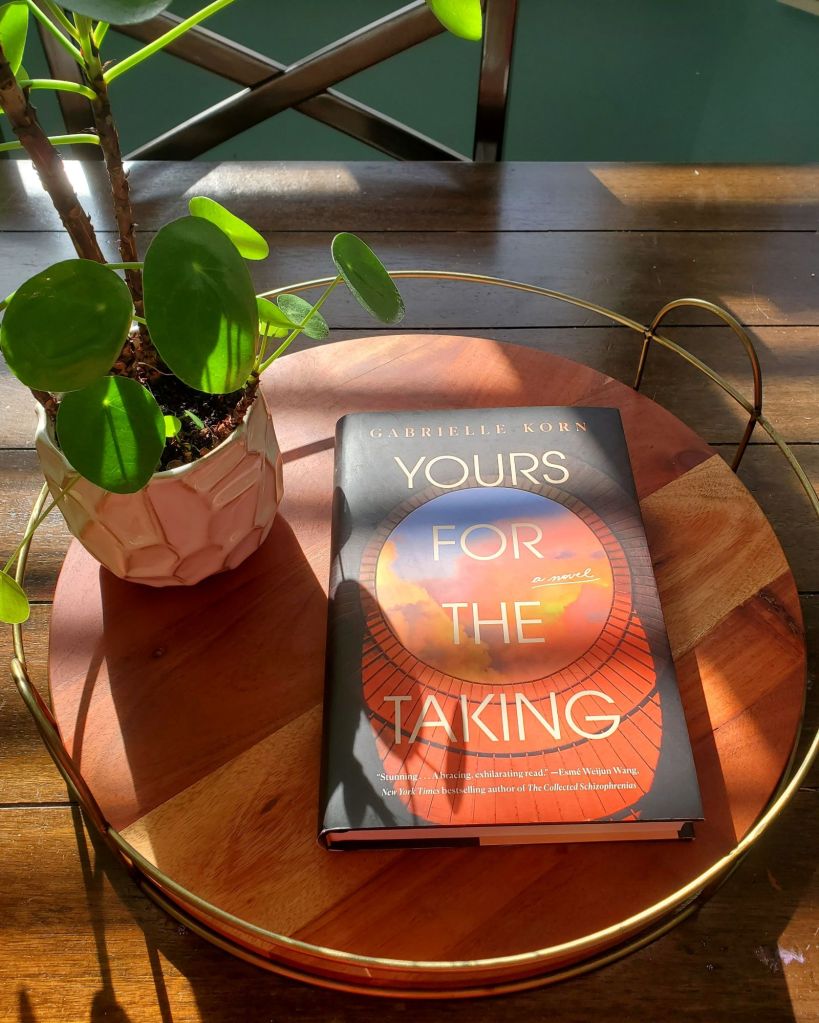
Book Review: Yours for the Taking by Gabrielle Korn

Yours for the Taking // Gabrielle Korn

A generation forward on the same path we’re currently trekking finds a world suffering even more extreme consequences of climate change driving a select few to enter protected weather-proofed indoor communities to ensure survival. One such community, located in New York City, is founded by #GirlBoss billionaire CEO and fourth-wave feminist Jacqueline Millender whose Inside Project space is furnished with soft pinks and mauves filled with a disturbing number of white, educated, upper middle class women, and founded on the idea that in order to heal our world the patriarchy must be eliminated. While Millender decamps with the other 1%ers to spaceships orbiting our dying planet her feminist utopia upstart slides towards a dystopic future.

Yours for the Taking {#gifted @stmartinspress} offers some truly interesting ideas for consideration about power structures, systems of stratification and exploitation, and the necessary elements for a functional society. While I really dug the concepts I do wish I had found the narrative a little more compelling. Still plenty to appreciate here and I hear there is a forthcoming sequel, which I’d be interested to read.

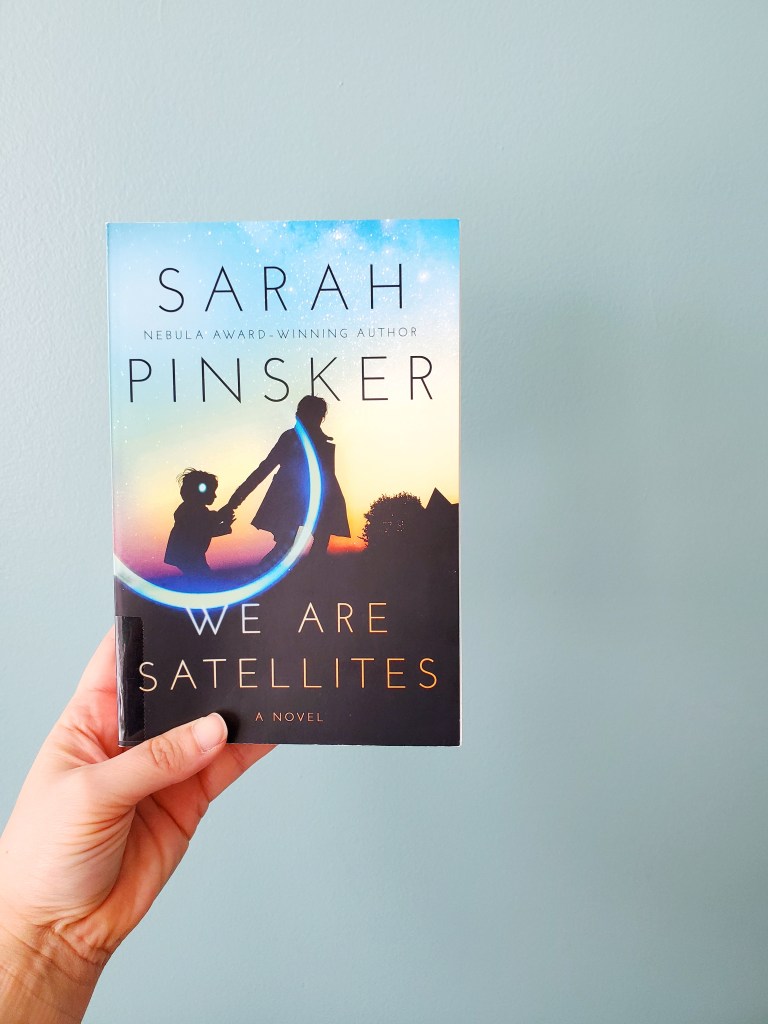
Book Review: We Are Satellites by Sarah Pinsker

We Are Satellites is a story set in a very near future where people eager for the next new technology are implanting a device into their brain which promises to help them multi-task. One family is caught up in the haves and have nots of it all.

Interesting premise, disappointing execution in my opinion.

I thought a lot more could be done with both the bigger picture (politics, capitalism, consumer culture, pervasiveness of tech, our brains on tech, this could have gone so many directions!) and the interpersonal dynamics of a family where two members opt in to the device (one with a positive experience, the other negative) and the other two don’t (one chooses not to, the other has a medical condition which renders them ineligible.)

Plus, honestly, who wants to undergo brain surgery just to become more efficient at multitasking? This holds no appeal for me. At least make the tech cool!

The most interesting thing to me was the idea that its hard to know how other’s brains work compared to our own, which had me questioning what’s normal? Am I normal? What is normal? Like, we only ever really see things from our own personal perspectives and we can never fully convey our POV to another person bc they’re receiving it from their own individual perspective filter. Being a person is weird when you start to think about stuff like this.

Anyhoo, do recommend contemplating how your brain works vs other people, do not recommend this book.

Book Review: Anthem by Noah Hawley

The absurdity of Vonnegut meets the dark fantasy of Stephen King’s The Stand in this speculative tale filled with fantastical creatures that is decidedly not a fairy tale because it’s too close to current reality.

In Noah Hawley’s Anthem a new plague is spreading – teen suicide. Young people are systematically ending their lives in droves with only the symbol “A11” left for explanation. The apocalypse has arrived in an eerily familiar world and it’s up to one ragtag group of teens to save us all.

I’m not sure whether Hawley has contributed anything new to the “legitimate political discourse” as humanity hurtles full throttle into the End Times, but he has written an incredibly provoking and horrifically entertaining modern classic quest of good vs evil.

Pairs well with Netflix’s Don’t Look Up.

Be sure to check content warnings if you like a head’s up on sensitive content before reading this one.